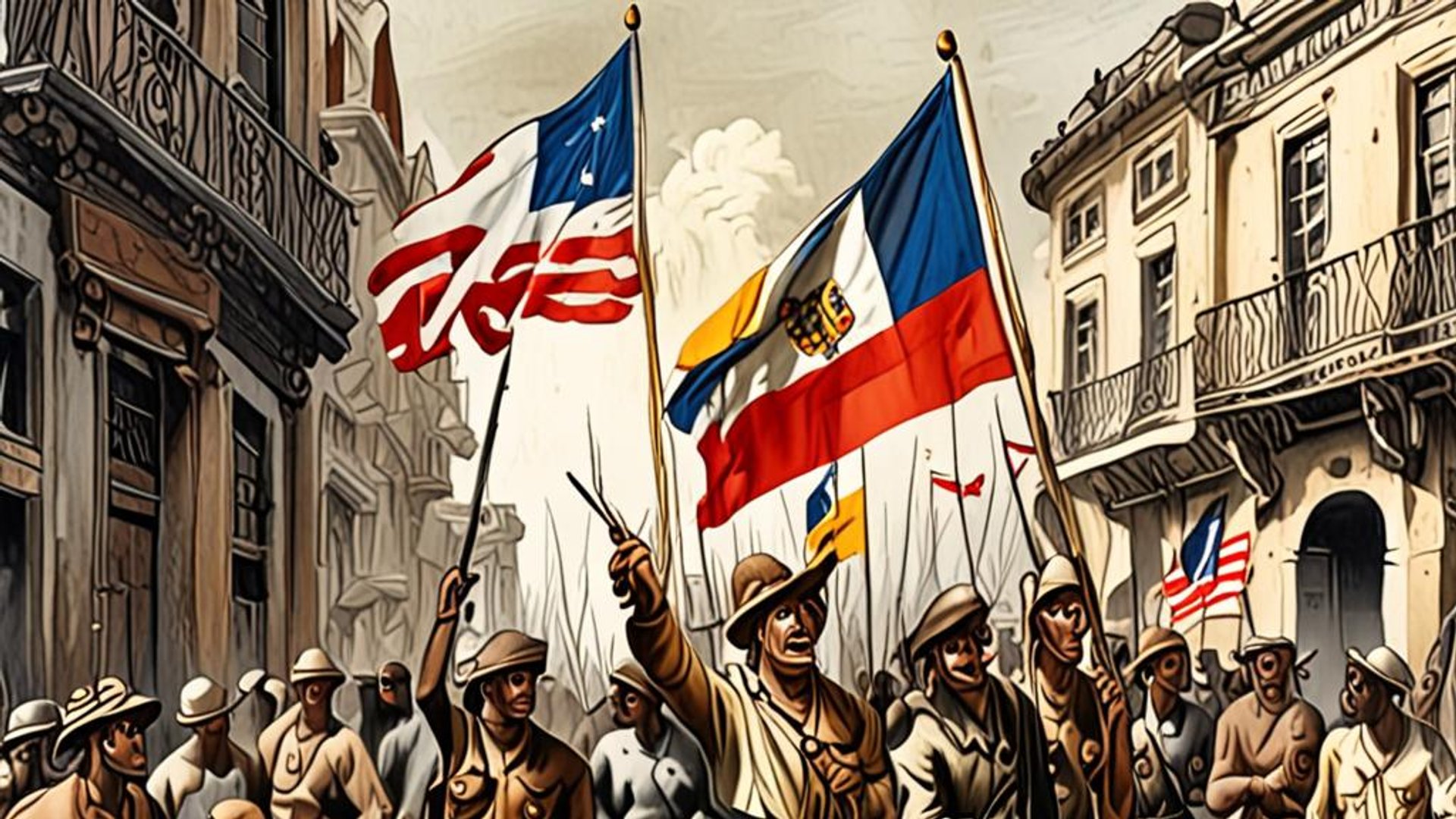
The island we now call Haiti and the Dominican Republic did not change hands because monarchs were whimsical. It moved with the tides of European war, sugar profits, and administrative exhaustion. Spain first recognized a fait accompli in the prosperous French west (1697), later ceded the Spanish east to Revolutionary France (1795), then clawed it back during the anti-Napoleonic upheaval (1808–1809) before diplomacy sealed the return (1814). Meanwhile the western colony fought a slave revolution and became Haiti (1804)—a new political fact that the old empires could not reverse. The confusion comes from names: "Haiti" didn't exist when Spain made its earliest concessions; the west was then Saint-Domingue. The east was Santo Domingo. The island's story is a ledger of power, not a parlor game of gifts.
I. Start at the Beginning: 1697 Isn't "Haiti," It's Saint-Domingue
By the late 1600s, French buccaneers and planters had turned the neglected western fringe of Spanish Hispaniola into a booming sugar and coffee machine. Spain could not eject them; France could defend them. The Nine Years' War ended with the Treaty of Rijswijk (1697), where Spain formally ceded the western third to France. France named it Saint-Domingue and made it the richest colony in the Caribbean. Spain still held the eastern two-thirds, Santo Domingo.
Why Spain yielded: it recognized a demographic and economic reality. The French west had slaves, mills, exports, and warships behind it; the Spanish east had decayed garrisons and pastoral estates. Rijswijk was not charity; it was bookkeeping.
II. 1795: Revolutionary France Wants the Rest of the Island
A century later Europe turned over again. Revolutionary France battered Spain on land; diplomacy finished the job at the Peace of Basel (22 July 1795). In that treaty Spain ceded the eastern half—Santo Domingo—to France. The swap helped Spain keep a slice of the Basque frontier (Gipuzkoa) and end a losing war. On paper, the tricolor now covered all Hispaniola.
But paper lagged events. France's writ in the east was thin. In 1801, Toussaint Louverture—general of the black revolution in the west—marched into Santo Domingo on behalf of the French Republic, abolished slavery there, and briefly unified the island under antislavery authority. Napoleon then dispatched Leclerc's expedition (1802) to oust Toussaint; civil war, yellow fever, and insurgency followed. In 1804 the western colony declared independence as Haiti. The east, however, remained formally under France until locals revolted later.
III. 1808–1809: Spain "Takes It Back" in the East
When Napoleon invaded Spain in 1808, loyalties snapped across the empire. In Santo Domingo, creole elites—backed by the Royal Navy—rose against the French administration. The Spanish reconquest of Santo Domingo culminated in 1809; French forces capitulated, and Spanish rule returned (a thin, underfunded rule Dominicans later called España Boba, "Meek Spain").
This is the "taken back by Spain" moment—only in the east. The French west had already become independent Haiti; Spain did not take Haiti back.
IV. 1814: Diplomats Write What the Battlefield Already Said
After Napoleon fell, the First Treaty of Paris (30 May 1814) tidied the map. Among its articles, France formally restored Santo Domingo to Spain, undoing the 1795 cession. The clause ratified the 1809 reality: Spain was already back in the east. France, for its part, still refused to recognize Haiti's independence for another decade, but recognition could not reoccupy what soldiers had lost.
V. Why the Story Sounds Like "Given to France, Taken Back, Given Again"
Because people compress two geographies and four dates into one sentence. Here is the clean sequence, with the names used at the time:
1697 — Rijswijk: Spain recognizes France's control of the western third (Saint-Domingue). (Not Haiti yet.)
1795 — Basel: Spain cedes the eastern half (Santo Domingo) to France. France now holds the island on paper.
1801–1804 — Revolution to independence: Toussaint occupies the east for France (1801); Haiti declares independence in the west (1804).
1808–1809 — Reconquest: Dominicans, with British help, expel the French and restore Spain in the east.
1814 — Paris: France formally returns Santo Domingo to Spain by treaty.
1821–1822: A brief Dominican bid for independence collapses; Haiti unifies the island under President Boyer until 1844, when the Dominican Republic secures its sovereignty.
Once you separate west vs. east and colony names vs. modern names, the "gave it / took it back / gave it again" proverb dissolves into two different theaters—Saint-Domingue/Haiti and Santo Domingo—moving on related but distinct tracks.
VI. Motives, Not Magic
War math. Rijswijk recorded the balance of force on the ground; Basel cashed out a losing Spanish war against Revolutionary France. Paris (1814) rewarded allies and restored older lines after Napoleon. Diplomacy followed guns.
Sugar arithmetic. France defended Saint-Domingue because it threw off extraordinary wealth; by the 1760s it was the most profitable colony in the Americas. Spain's eastern half could not match that scale.
Administrative fatigue. The Spanish Crown faced continental war and rebellion across the Americas. In the years 1809–1821 (España Boba), Madrid barely funded the east; local initiatives and British sea power mattered more than royal plans.
A revolution that changed the rules. Haiti's independence—won by enslaved people—created a fact the empires could not erase, whatever the treaties said.
VII. The Clean Timeline
The island's sovereignty follows two parallel tracks:
West to France (1697) → Haiti through revolution (1804).
East to France (1795) → East back to Spain (1809, confirmed 1814) → later Haitian unification (1822) → Dominican independence (1844).
The confusion arises when these two stories are compressed into one sentence without separating west from east, or colony names from modern nations. Once you track each territory separately, the apparent back-and-forth becomes two distinct paths.
VIII. One Island, Two Stories
Hispaniola shows how empires claim maps while people make facts. Spain and France traded signatures; sailors and insurgents decided outcomes. Sugar created wealth; wealth invited war; war opened doors that enslaved people kicked wide. If you keep the compass points straight—west/east, colony/modern name—the island's shifting flags stop looking like caprice and start reading like history.
This article is part of the Sol Meridian Latitudes series, examining hemispheric connections and contested geographies.